Panoramic: Automotive and Mobility 2025

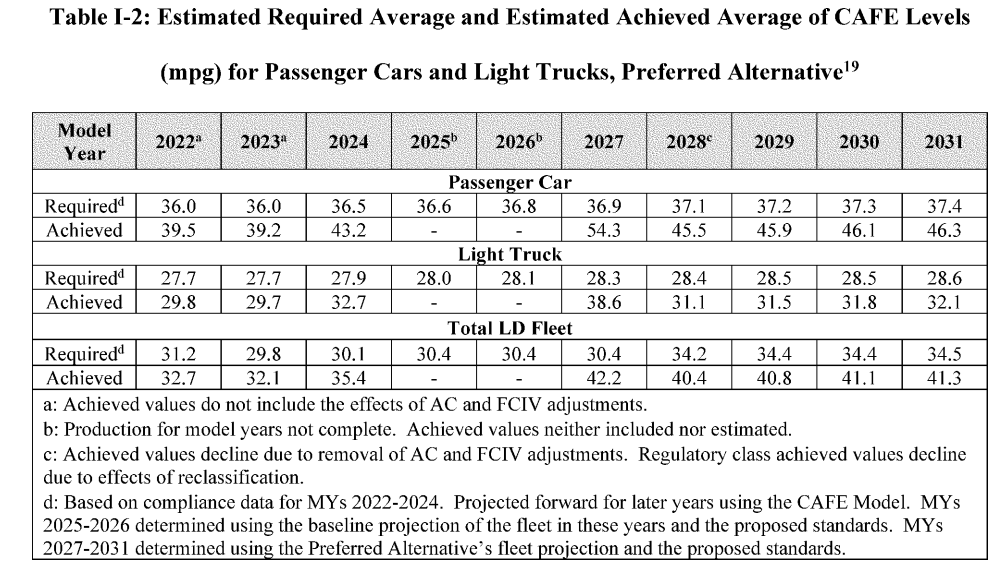
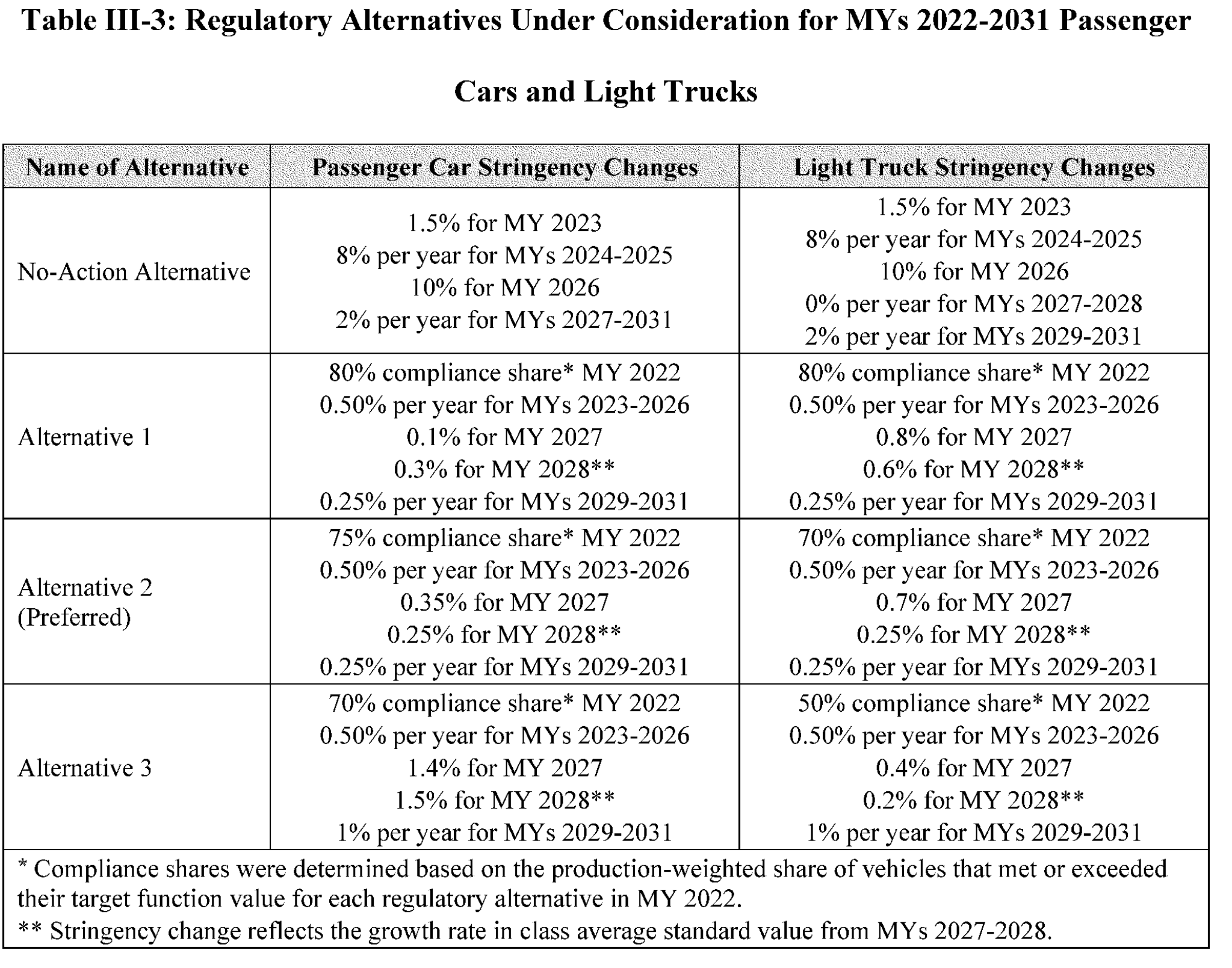
On December 5, 2025, the National Highway Traffic Safety Administration (NHTSA) issued a notice of proposed rulemaking (NPRM) for the new “The Safer Affordable Fuel-Efficient (SAFE) Vehicles Rule III for Model Years 2022 to 2031 Passenger Cars and Light Trucks.” 90 Fed. Reg. 56,438 (Dec. 5, 2025). The NPRM proposes to reach back to revise fuel economy standards starting from newly proposed model year (MY) 2022 standards and then increasing in stringency at a rate of 0.5% per year through MY2026, followed by 0.25% per year through MY2031. By MY 2031, the revised standards would require an industry-wide fleet average of approximately 34.5 miles per gallon (mpg) for all light-duty vehicles (down from approximately 50.4 mpg finalized in prior standards set in 2024). Unlike the previous proposed and final rule under the Biden Administration, this NPRM does not propose any non-binding augural standards for MY 2032 and beyond.
In explaining its reach back to MY 2022, NHTSA indicated that this was consistent with the directive set forth in the January 28, 2025, “Fixing the CAFE Program” memorandum and is also the earliest model year for which NTHSA has not yet concluded CAFE compliance proceedings. NHTSA emphasizes that its proposed new standards do not rely on the imputed fuel-economy performance of EVs or the electric operation of PHEVs, and thus “brings the CAFE program into compliance with statutory restrictions” by avoiding “consideration of impermissible factors” used to set the current standards. 90 Fed. Reg. 56,438, 56,444, 56,447. Among other things, NHTSA states that the proposal is intended to enhance consumer choice and reduce regulatory burdens on automakers. According to NHTSA, the proposal will make vehicles more affordable and easier to manufacture, reducing estimated up-front vehicle costs by $900.
NHTSA proposes to reclassify the light-duty fleet, focusing on vehicles that are “primarily designed to move people” for the passenger car fleet, and vehicles “primarily designed to operate off road or move cargo” for the light truck fleet. In practice, this means that a number of vehicle models that are currently considered to be lower fuel economy light trucks would be moved to the passenger fleet. NHTSA also proposes to update the classification criteria from technology-based to performance-based standards, where applicable.
Estimated Required Average and Estimated Achieved Average of CAFE Levels (in mpg) for the Preferred Alternative
The NPRM also proposes the minimum domestic passenger car targets as follows:

Unlike prior recent rulemakings, as proposed, the NPRM includes some significant changes to the structure of the CAFE program and inter-manufacturer credit trading, and carry-back/forward provisions. Proposed changes to the CAFE program include, but are not limited to:
Although acknowledging that prior rulemakings considered standards set by the California Air Resources Board (CARB) and prominence of BEVs in the market, the NPRM explicitly rejects consideration of CARB standards as preempted by the Energy Policy and Conservation Act (EPCA) and also references the three resolutions under the Congressional Review Act (CRA) which disapproved of the preemption waivers granted by CARB to enforce the Advanced Clean Cars (ACC) II program, among others. NHTSA also states that the proposal did not incorporate EPA’s non-criteria emission standards, due to the proposed rescission of EPA’ Endangerment Finding and greenhouse gas (GHG) standards for light-, medium-, and heavy-duty vehicles.
NHTSA considered a range of regulatory alternatives for each fleet, including two regulatory alternatives for passenger cars and light trucks as well as a No-Action Alternative, as follows:
Regulatory Alternatives Under Consideration
In addition to feedback on the technical basis for the proposal and modelling, NHTSA requests comment on, among other things:
Notably, NHTSA also requested comment on the extent to which credits change manufacturers compliance behavior and value of credits in light of the updated civil penalty rate ($0). While it remains to be seen how NHTSA will finalize these proposals, pursuant to Congressional action, we note that Congress amended EPCA as part of the One Big Beautiful Bill Act to set the CAFE penalty rate to $0 for MY 2022 and beyond. See Public Law 119–21 (OB3), 139 Stat. 72 (July 4, 2025). This proposal is therefore intended to remove references to civil penalties in 49 C.F.R. Part 536, consistent with the statutory amendment. See 49 C.F.R. §§ 536.5(d)(2), (6); 536.9(e); 536.10(b); 536.7(b)-(d).
NHTSA will hold a public hearing on the proposed SAFE III rule on January 7, 2025 (with an additional session on January 8 if necessary) and requests written comments by January 20, 2026.
Authored by Joanne Rotondi, Hannah Graae, and Allisa Newman.